A Story of Revolution Today: An Interview w/ Tomas Rothaus
The recent history of mass protests holds hidden lessons for insurrections today.
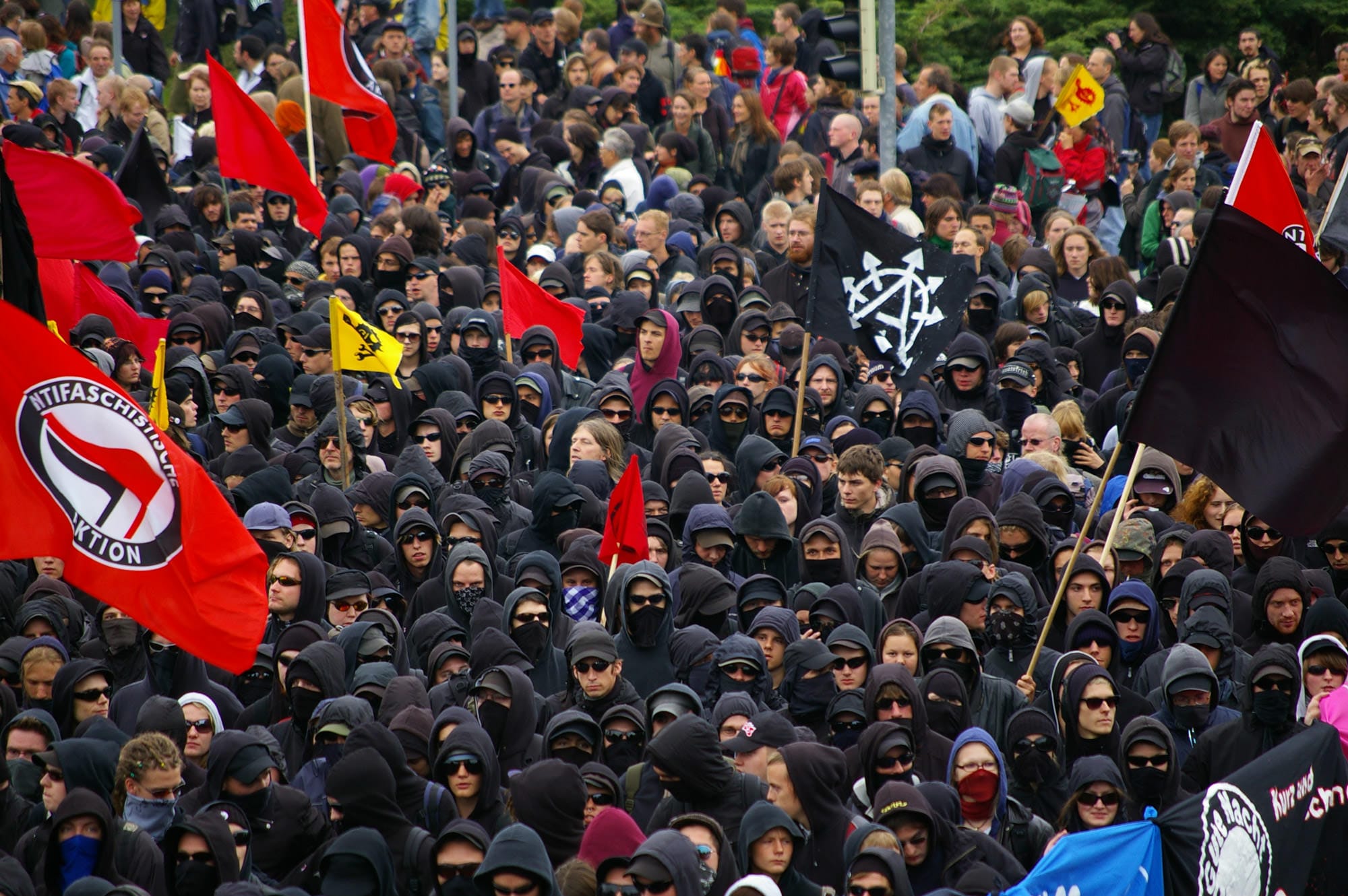
While social movements tacitly acknowledge that they are simply the razor’s edge of a much longer ancestry of militants, that acknowledgment is rarely more than rhetoric, a meme to help communicate the needs of today. There are common-sense reasons for that: there is enough directly in front of us to occupy our attention, and conditions certainly have changed. Which is why it’s important to intentionally reach back and revive history, so we can place ourselves into that story and remember the lessons so many have already learned.
This is part of what Tomas Rathous has done with his antifascist movement memoir Another War Is Possible: Militant Anarchist Experiences in the Antiglobalization Era from PM Press, which chronicles his time in the anarchist, antifascist, and anti-globalization movements across Europe and the Americas in the 1990s and 2000s. This was a period of incredible global uprising against transnational institutions of capital and the far right, as well as the state forces that acted as their defenders. The book spans years, some of which provide a fresh angle on a well-worn story, and others that recount struggles largely erased from the anglophone press. Together, they offer a methodical reappraisal of strategy and tactics, as Rathous actively digs into these narratives to uncover the kind of transhistorical meaning they may contain.
I spoke with Rathous across borders and time zones about his book, his time in militant, street-level social movements, and the inspirations they hold for us today.
Shane Burley: First, how do you understand antifascism and its relationship to anarchism? You write about them in the book as totally connected, even though many of the street-level fascists don’t have state power and the institutions you were fighting in the counter-globalization movement were state sanctioned. How do you see the relationship between those two?
Tomas Rathous: In my understanding, they are existentially inseparable from one another—at least with regard to the relationship between anarchism and antifascism. Ideologically, fascism is a project and vision for society that, with its nationalism and authoritarianism, is diametrically opposed to the anarchist idea. Further, its exterminationist fantasies, as well as the horrors it has already perpetrated throughout the 20th century (the Holocaust, ethnic cleansing, mass murder, etc.), horrify my anarchist conscience.
I’m an anarchist because I want a world free of classes, nations, and borders. I’m an antifascist because fascism stands in direct opposition to that project and vision—and by extension I’m an anti-capitalist, because the structural and necessary shortcomings of capitalism are the fertile grounds of white grievance and resentment, the poisoned soil from which fascist movements, such as today’s MAGA, cyclically re-emerge. The interests of capitalists, the state, and fascists are very much not always aligned, and it is a strategic mistake to simplify our analysis as if they were simply different arms of the same enemy. They can, and do, come into conflict with each other as well, just as they do with us. Even today, despite the fact that the MAGA fascists have largely captured the levers of state power, there continue to be internal conflicts among them.
Precisely that reality—that fascists have largely captured the levers of the world’s primary superpower—also represents new terrain for contemporary antifascism in the Northern Hemisphere. Most of us, myself included, are experienced at fighting to keep fascists at bay, to keep them on the fringes of the political landscape, and to reduce the concrete physical harm they can inflict on those they deem outside of their idealized national identity (wrong religion, leftists, queers, immigrants, etc.). But now we face fascists whose narratives are normalized in mass media, who can amplify white supremacist messaging from official government social media accounts, who can avoid street fights that alienate “regular people” because the state now carries out its punitive expeditions for them (see ICE activity across the U.S. or National Guard deployments), and who benefit from all the strategic advantages granted by state power. I’m not confident that the tactics and instincts of our classic militant antifascism from the 1980s until today are still relevant.
As a closing note in that regard: while every anarchist should be an antifascist, the same is not true in reverse—nor does it need to be. We can disagree with those opposed to fascism who don’t share our analysis of its root causes or how to effectively eradicate it, but antifascism, especially today, requires a broad and welcoming front of all those opposed to fascism. Every anarchist has to be an antifascist; not every antifascist has to be an anarchist.
SB: One thing that was especially interesting was the focus on supporting undocumented migrants, which you write about as a logical extension of antifascist politics. What role did migrant solidarity play in your larger political work, and what tactics and strategies did you find to be successful, as much as you can tell? This is something people in the U.S. are thinking about very intensely right now, and your experience in places like France feels especially instructive.
TR: Immigrant solidarity is for me a very logical, practical consequence of my anarchist and antifascist politics. It allows us to build bridges with vulnerable and marginalized people and communities through concrete, tangible solidarity, while at the same time directly negating the principle of states and borders—positing unequivocally that a human being’s right to autonomy and free movement trumps any absurd and barbaric construct centered on whether that person happens to be born on the correct piece of land, or whether they have a specific piece of paper or not.
My first years as an anarchist militant and organizer were during the height of the undocumented immigrant solidarity movement in Paris in the 1990s. While the political context we existed in was wildly different from what comrades in the U.S. face today—our government was a Socialist Party, Communist Party, and Green Party coalition that could not afford to be seen as overly vicious or repressive toward the “adventurists” or “extremists” of its own side—I think the general toolbox and focus remains the same.
Mass, broad, above-ground work to educate communities about low-risk ways to resist and hinder the deportation infrastructure. Collective action to tie up the resources of the deportation machinery. Given how massive and well-funded the deportation machine is in the U.S., I’m sure it feels like pushing against the wind—but their resources are still finite, and behind those masks are individuals who can and do get tired and frustrated when they encounter blockades everywhere, people yelling at them, whistles, cars driving slowly, slashed tires, and so on. There is a wide network of private actors who profit from the incarceration of human beings, the separation of families, and the reality that gangs of masked people kidnap humans off the streets. Airlines, hotels, car rental companies. Most of these actors operate according to basic capitalist logic. The political and economic cost of doing business with ICE, DHS, and similar agencies should be higher than the benefit.
In France, for example, it was the ACCOR hotel chain that rented rooms to the government to hold immigrants prior to deportation, and Air France that allowed the government to use space on its planes. Several chapters of Another War Is Possible discuss our struggle against them specifically: occupying the roofs of their hotels, ransacking their lobbies, tagging their buildings, talking to passengers at airports and trying to induce their solidarity, and so on.
We need to understand that no matter how unpopular Trumpism is in general, or off-the-street kidnappings in particular, if there is a lesson we should have learned by now—such as from the millions who took to the streets to oppose the Iraq War—it’s that if we do not disrupt the workings of power and/or the economy, nothing matters.
SB: Your memoir unpacks debates that happen not just inside social movements, but on actual streets in real-time moments of conflict, particularly around how to balance mass participation and militant action. In your experience, how were those considerations balanced? And how do you think about that balance today, many years later?
TR: I’ve always been, or at least tried to be, an advocate of a diversity of tactics and of making good strategic use of the different tools in the aspiring revolutionary’s toolkit. Like any tool—if I take a wrench to screw in a bolt, it’s a great tool. But if I use it to hang a painting, chances are I won’t get very far. The same can be said of a black bloc. If the aim is a mass militant action, it’s a great tool. But if we want a large display of solidarity without demonstrating a movement’s combative capacity, it might not be the right option.
Strategies and tactics need to be aligned with goals and objectives. That’s easy to say, much harder to apply. It requires an accurate analysis of material conditions, the balance of power, the capacities of your comrades, and countless other variables.
To generalize, movements are healthiest and most effective when they can draw on complementary strategies and adapt rapidly. On one hand, allowing broad participation; on the other, wearing down the state’s capacity and protecting against criminalization. I often point to the anarchist ecosystem in France: inclusive demonstrations, black blocs, anarchist unions, bookstores, infoshops, newspapers, radio stations, semi-clandestine antifascist groups, and cultural spaces. For newcomers, this ecosystem is welcoming. For the state, it is difficult to isolate and repress.
SB: Your memoir really unpacks a lot of debates that happen not just inside of social movements, but on actual streets in real-time moments of conflict, and a number of these debates center the question of how to balance mass participation and militant action. In your experience, how were those considerations balanced? As people were considering tactics and planning for major confrontations, were there considerations for how to grow the level of participation, and did that soften your perception of what types of tactics were viable? And just as importantly, how do you think about that balance today, many years later than some of the actions you remember in the book?
TR: I’ve always been, or at least like to think that I tried to be, an advocate of a diversity of tactics and of making good strategic use of the different tools in the aspiring revolutionary’s toolkit. Like any tool, if I take a wrench to screw in a bolt, it’s a great tool. But if I use it to try to hang up a painting, chances are I won’t get very far. The same can be said, for example, of a black bloc. If the aim is for a mass militant action, it’s a great tool. But if we just want a large display of solidarity, without the display of a movement’s combative capacity, it might not be a great option.
Like most things in life, strategies and tactics need to be aligned with goals and objectives. Which is easy to say or write, but much harder to apply in practice. It’s a task that requires a correct analysis of the material conditions around you, the balance of power between your movement and your opponents, the capabilities of yourself and your comrades, and who knows however many further variables depending on the time, place, and context.
To generalize though, I think movements are at their healthiest, and thus most effective, when they can both draw on complementary strategies and adapt rapidly to the situations with which they are faced: on the one hand to allow for the broadest possible scope of participation, and on the other to both wear thin the capacities of the state, as well as protect against inevitable attempts at criminalization. Here again I would point to the ecosystem, for example, of anarchism in France, where you will see inclusive demonstrations with anarchist blocs marching from point A to point B in which anybody can feel relatively safe to participate; black blocs; relatively large anarchist unions; social and political structures like bookstores, infoshops, newspapers, magazines, and radio stations; semi-clandestine antifascist groups; a cultural ecosystem of bars, social centers, concerts; and so forth. As a sympathizer or a person new to anarchism, this is the ecosystem I’d like to encounter. And for the state, this is an anarchism which is difficult to isolate and criminalize.
SB: You give a pretty clear picture of the antifascist movement during the early 2000s and the types of physical confrontation that was used against far-right crews. One question I think a lot of us are asking today is how to scale those tactics up if and when the far right has state power. What do you think militant antifascism looks like when it’s not neo-Nazi skinhead gangs that are attacking you, but police forces who have the legal monopoly on violence? Does that change your sense of what’s possible? On a side note, I think another question we often have is how things change when firearms are common. I live in Oregon, everyone I know owns and carries firearms, and so do the fascists, so that obviously escalates the tension.
TR: This is something I’ve been thinking a lot about over the last year or two, since the second Trump victory started to seem, if not inevitable, then at least like a reasonably viable possibility. And I need to preface it by saying that I, and based on conversations I’ve had with other comrades I think I’m not alone in this, was caught somewhat unprepared, as the realities of Trump 2.0 seem to be worse, more intense, and more acute than even my worst-case predictions.
So while I’ve been thinking about it, and I touch on this in the first question, I really do believe that even for some of us who have a few decades of very intense and hands-on experience with the question, we are in fact in uncharted territory for contemporary antifascism in the “first world.” I don’t know, and certainly don’t want to pretend to know, what the winning strategy is or what the way out can look like. I’m fairly certain fighting them on the streets is, while still sometimes necessary, no longer central, as the fascists have delegated most of their street-level intimidation and violence to the state.
I’m concerned about us falling into patterns of antifascist magical thinking, convincing ourselves that fascism and fascists are inevitably bound to lose. If we look at the defeat of the central traditional fascist powers, two of the three fell primarily to the military might of other state actors (Nazi Germany and fascist Italy), while the third fell essentially under its own weight, but only after almost 40 years and due to the death of its figurehead (fascist Spain). This is of course not to minimize or trivialize the efforts, achievements, and sacrifices of generations of antifascists who opposed these regimes. But it would be ahistorical, and a dangerous message to those fighting today, to pretend that militant grassroots opposition to a fascist state is, in and of itself, an inevitable recipe for victory. It can be. It could be. I hope that it is. But there’s definitely no guarantee of it.
What I can say is what I feel gives me hope, and I assume has a similar effect on others. The uprising in Los Angeles, for example, was a message to both friend and foe that there are communities who will not allow their neighbors to be snatched from them without a visceral reaction. We as anarchists and antifascists should make sure that we are always positioned to support these communities and to enhance these moments of rebellion.
That aside, I wish I had a better answer, but I simply don’t.
As to firearms: it’s definitely a shift which happened in the last decade or two, even in the U.S. Of course I know there has always been more firearms in the U.S. than, for example, in Europe, but even in the early 2000s it was considered rare and out of context for either side to appear at a demonstration with a gun. I still remember ARA folks showing up with bulletproof vests at the mobilization against the Nazis in York, PA in January 2002 and thinking to myself that it seemed like a little much (although I realized a few hours later that it wasn’t quite as exaggerated as I thought when I found myself with a Nazi putting a gun to my head). Today, I’m not in the U.S. and don’t want to speak for comrades, but I think it would probably be straight up negligent for a crew to engage in confrontation with fascists without at least making sure there is an armed rearguard (which makes our way of operating back in France seem quaint, as the rearguard carried tear gas and CS spray in case we needed to retreat).
SB: You talk about some of the backlash against antifascists, particularly after the Gothenburg action, where antifascists were demonized for disorder and blamed for state repression. This is not at all unlike what took place in the U.S. at the end of the 2010s, and is still continuing today. Did this shift in perception about antifascists make you rethink the tactics used in actions like Gothenburg, or is it simply a sign that antifascists and anarchists will be demonized no matter what we do? I hate to think about it as a public relations issue, but were there times that you feared some types of militant actions hindered the ability to grow the movement?
TR: As a general starting point, I should make clear that I’m broadly against defanging antifascism or anarchism for the sake of optics. We are, should be, and need to be a militant and combative movement. That said, we also probably shouldn’t performatively be a caricature of ourselves just for the sake of militant posturing. That alienates people, and alienating people is certainly not the objective, at least not unnecessarily.
But that does pose the question: we can’t and won’t appeal to everybody, so who are we trying to reach? What do we want from those people who we do reach? And how do we want to reach them?
Our perspective back then was: there are those who, based on their lived experience and material conditions, will understand our rage, they will understand the forms of action we are taking. The young, the marginalized, the immigrant. They understand why we attack the symbols of wage labor, because they know what it’s like to have the hours of your day stolen from you for somebody else’s profit. They understand that the cop in the neighborhood is there to control them and possibly deport them, not to protect them. They understand that fascists aren’t a matter of quaint political debate, but a clear and present danger liable to take their lives on a dark street on any random night. So when we destroy the symbols of capital, when we attack the cops, and when we hunt the Nazis instead of waiting to be hunted, these are segments of society which are liable to see us through those actions as not just allies, but accomplices. It’s in part through this perspective and praxis that anarchism in Greece has built such deep ties with immigrant and marginalized communities. They understand that our solidarity isn’t just of words, but of action.
The opinions of the rest of society? How much do I care really? Other kinds of outreach work are important, no doubt. But I personally have found that I’m very often simply not the right person for that. I’m a bad spokesperson and have trouble engaging with people who simply don’t seem to even share a reality with me, much less an opinion.
SB: Your encounter with the exiles of the CNT in France seems to play an inspiring role early in your anarchism. What were the lessons from the CNT and the Spanish Revolution that informed how you thought about revolutionary movements? They offered a serious model of community self-defense. Did that inform your antifascist politics and strategy?
TR: My exposure to the exiled comrades from the Spanish Revolution and Civil War was undoubtedly instrumental in not just informing the shape of my anarchist praxis, but I would say that, together with the Argentine uprising of December 2001, were the elements that cemented anarchism in my conscience. I won’t discuss the Argentina example here since that would be too much to chew off for the purposes of this interview, other than to say that it illustrated to me how quickly things can change, how much can happen in so little time, how powerful the collective “we” of popular action can be even when we feel like we are in moments of defeat and disarray, but most of all how quickly the human spirit reverts to solidarity and mutual aid when scarcity and competition are removed from the immediate equation of daily survival.
But back to the exiles of the Spanish CNT: I don’t think I took too much practically from their models of community self-defense or resistance, since they were from a time and reality that was radically different than ours. What I did take was a deep understanding, despite my very young age, that to be an anarchist militant was to be a further link in a chain of sacrifice and struggle in defense of human dignity and solidarity that spanned back over a century. That it was much more than punk rock, youthful rebellion, or what have you, but a very much real and practical roadmap for a completely different way of understanding human relations and society as a whole. And that many people had made some very serious sacrifices and suffered incredible consequences in pursuit of this idea. That’s why I often understood anarchism as a personal responsibility, a set of obligations that my conscience demanded of me. (Which, I’m well aware, was not always the healthiest of perspectives.)
SB: What do you think the relationship between antifascism and mutual aid is?
TR: Mutual aid is vitally important in the construction of a broad front against the normalization and spread of fascist ideas. I can illustrate it, hopefully briefly, with one example. I just finished translating Miquel Ramos’ book on antifascism in the post-Franco Spanish state. In it, there is a chapter titled “Community Building: The Labor of Slowing Down the Far Right.” The chapter describes numerous examples of autonomous social centers, usually started and run by anarchists and antifascists, and their implantation in working-class neighborhoods with significant immigrant communities. These spaces are almost always places where regular people, outside of the usual activist ghetto, can participate in sporting activities, cultural activities, or even a variety of mutual aid exchanges. One particular example, in which anarchists opened up a communal housing structure in the community, illustrates the value of such spaces and experiences of mutual aid to the practical struggle against fascism:
“Some of the residents are long-term unemployed and view the accommodation of homeless people in the community with suspicion. After endless meetings and a lot of education, we managed to get them to accept. The same thing happened later with migrants and then with Roma people. In the end, it’s about sharing and living together to break down those prejudices. When you depend on the communal pot cooked by the Colombian family, racism doesn’t hold up. Just as when the Maghreb mother picks up your children from school because you are working, just as when children of different nationalities play together, you finally achieve more cohesive communities that are a bulwark against racism.”
(Ruyman Rodriguez, Anarchist Federation of Gran Canaria)
SB: We are in another era of mass state repression in the U.S. This is something that you witnessed during the counter-globalization movement, particularly the demonization of anarchists and militants. What lessons did you learn from those experiences that you think will be applicable to folks in the U.S., and elsewhere, as they face potential repression?
TR: Honestly, the repression against us was quaint compared to today’s situation and standards. Again, I don’t want to at all trivialize or minimize the experiences of comrades from back then who suffered it (I off the top of my head recall a couple of examples like a comrade in Eugene, I believe, who did several years for throwing a stone or two, and another in Long Beach, for example, who got a couple of years for conspiracy or some such around an anti-Nazi mobilization).
But by and large I’m shocked and terrified at how run-of-the-mill civil disobedience or militant action are now stigmatized as “terrorism.” The impunity with which the media describes demonstrators as “rioters,” even when there is no riot taking place or even having taken place, and the extent of the success fascists are having at creating repressive realities out of their conspiracies and fantasies.
It’s the ultra reactionary media landscape and the repressive social consensus that landscape has created which has by and large enabled this. That, combined with the fact that on the antifascist front there is no longer just about any daylight between our classic opponents on the fascist far right and the traditional conservatives of the old-school Republican spectrum, we are therefore unsurprisingly public enemy number one for them and extremely exposed to the whims of state repression, a state which they now wield the levers of to do essentially as they please with.
If there is one lesson we can take from all of this, it’s that repression is more often than not a function of the balance of political power, between our forces and those of the state and or fascists (depending on how aligned those two happen to be at any given point in time).
Here again, I’ll illustrate with a lived example: in February of 2011 thousands of antifascists successfully sabotaged and stopped Europe’s largest neo-Nazi demonstration in the German city of Dresden, through a combination of non-violent blockades and militant actions, in which antifascists erected and set fire to barricades, fought running battles with the cops, and even often charged police lines. The German state responded by creating a special working group dedicated exclusively to investigating and prosecuting the “left-wing radicals” responsible for the “violence and vandalism.” Hundreds, if not thousands, of man hours were invested in reviewing security camera footage, police recordings, testimony from undercovers in the crowd, and even cross-checking thousands of cellphones to see which known “left wing extremists” were in the area on that day. Eventually, almost a full year later, several activists were arrested by masked squads in pre-dawn raids across the country and presented with serious charges.
As this was happening, I found myself in Athens, discussing the situation with trusted comrades who I knew from the early 2000s and the height of the anti-globalization mobilizations (Genoa, etc.). I remember their looks of confusion and disbelief as I tried to explain how serious it all was for us and how concerned we were about the developing and upcoming wave of repression. They kept rather incredulously repeating, part assertion part question, if indeed the only thing “we” had done was throw some stones and erected some barricades. “There can’t be such repression for so little, for such a normal activity in the political landscape.” And the line which sticks with me to this day: “Society would never accept it.”
And it makes sense. Because in the Greece of those days, mass militance and conflict in the streets were seen by large sectors of society as normal, acceptable, and possibly even healthy signs of dissent within society. Either due to its recent past, or because the anarchist movement had made it a point to make conflict with the state a regularly occurring phenomenon, or most likely a combination of both, the conditions for repression of run-of-the-mill mass militance on behalf of the state were simply not present. In Germany, by very stark contrast, the overwhelming majority of society disapproved of disorder on the streets, however noble the cause, and was wildly supportive of police action to repress it.
It’s this balance of power that anarchists and antifascists need to be acutely aware of when we determine what the possible sphere of action is, how we will be perceived (in cases where that is of concern), what our chances of success are, and what potential consequences we will be exposed to. And then of course the closely related question: how do we expand the sphere of action? How do we normalize resistance and disobedience? Which tactics empower others and allow for easy participation? But again, different objectives, different tactics. Sometimes a specific objective will require a more clandestine form of action in order to achieve a very specific goal, whereas sometimes that objective is more symbolic and more free-flowing methods are applicable.
SB: Where do you see the biggest bright spots of antifascist and anarchist resistance today? What do they teach us about resistance?
TR: First of all, I want to make sure that I don’t fall into the trap of anarcho-cheerleading. We aren’t doing ourselves any favors by convincing ourselves that our opponents are in fact weak. That while not the majority, a solid 20 to 30 percent of a country being rabidly xenophobic and racist isn’t a huge hostile mass facing us. There are probably 100 MAGA fascists for every one antifascist. They hold state power and, almost as importantly, they’ve largely normalized or at least mainstreamed narratives and talking points that not that long ago could be found almost exclusively on neo-Nazi chat forums or KKK flyers. We are in a dark and difficult moment, and no, the “arc of justice” or whatever does not magically bend towards progress. Likewise, it is unlikely that anybody is coming to save us, and I wouldn’t hold my breath that a Democrat win in the next elections will hold these people accountable to any relevant extent.
As a lifelong antifascist, I’ve always been on the side of being very careful with what and who we call fascists and fascism, so as to not banalize what it actually is and represents. And while the fascists in the U.S. may not yet have consolidated power fully (hence why one can still, to an extent, demonstrate, protest, write, etc. without the guarantee of repression), MAGA is clearly a fascist movement, and a quick glance at the propaganda put out on the social media of DHS, the White House, Homeland Security makes this abundantly clear. It is indistinguishable from classic fascist and neo-Nazi messaging and imagery.
All that being said, the bright spots of resistance today, what gives me hope among the doomscrolling when I get up and start reading the laundry list of the day’s new fresh fascist horrors, is the amount of people I see who stand up and resist. Concretely, the community defense groups who are out there day in and day out following ICE and CBP vehicles, warning neighbors, blowing whistles, making scenes, slowing them down, putting their bodies on the line at ICE facilities, putting pressure on the hotels that house them, grinding down the operations of places like Home Depot, and participating in so many of the myriad ways in which it’s possible to put sand in the gears of the deportation machine. These people are heroes in my book, full stop.
But not only that, I can imagine few ways more effective at illustrating the effectiveness of practical antifascism, at building networks with immigrant and vulnerable communities, and even at providing our own militants with experience and confidence to slowly expand their audacity and range of action against the masked fascists in their communities than the experience they are gaining from having to be on the ground in this manner for such a prolonged period of time.
My hope, and I don’t know how realistic it is, is that this dynamic and these groups will incubate the conditions for an explosion of rejection when the day comes that ICE or CBP go after the wrong person, on the wrong street, at the wrong time. Similar to what the case was in Los Angeles. I want to think that we are a spark away from a fire igniting, but we’ll only know if we keep creating sparks.
SB: How do you think about balancing militancy and mass participation?
TR: I think we covered this largely in the previous questions. But the summary would be that I’m of the opinion that our movements need to be as broad and inclusive as possible, in order to be effective. That means that there should be space for all to participate to the extent that they are willing and able, and that needless to say can take myriads of different forms. We need strategies and forms of action that are complementary and adapted to the social, political, and repressive realities in which we organize and fight. I feel like I’m speaking in clichés and platitudes, but that’s been at least my experience.
And again, as I said above, sometimes the objective is a broadly political one of messaging, in which case mass militance and mass participation are easier to incorporate (example: confronting cops and the security apparatus at a summit in order to send a symbolic message of resistance). In other cases, where there is a very specific objective, such as neutralizing a fascist threat or actions against deportation infrastructure, less open methods are necessary. And there is even a middle ground, which I describe in the book as used by the Parisian Anti-Deportation Collective, in which people were broadly told the subject of the action, the expected risk level, and a place and time to meet, but not the details of the specific objective.
SB: You may have also recently heard that there had been yet another attempt to criminalize antifascism, this time by declaring antifascist and anarchist groups in Europe as “foreign terrorist organizations.” They do it this way since it’s the only way to designate terrorist organizations since there isn’t a legally recognized domestic terrorism label, but it does make it illegal to, for example, donate to groups like that. I was curious to add a question just about what you think the implications of a change like this could be? For example, one of the groups now named a global terror organization is the Informal Anarchist Federation. It almost seems like they just selected groups by random.
TR: During past red scares, be it in the U.S., in Europe, or in South America even, we were actually powerful, an actual threat either as anarchists to power, or as antifascists to our ideological opponents. In the U.S., I don’t believe this is the case today at all, and that frightens me terribly. We are a weak, disorganized, disoriented, marginal, and numerically small movement, facing an unfathomably powerful enemy, which even aside from its current proximity to power, is also numerically simply much larger than ours, which is instrumentalizing repression against anarchist and antifascist movements for several purposes.
On the one hand, the obvious and most often discussed tool of branding the idea of antifascism as terrorism, to use as a sweeping tool of repression and criminalization of dissent and resistance of any stripe. But I think equally at play is that actual ideologically driven fascists and white supremacists (I prefer not to continue normalizing the term “white nationalist,” which used to be the sanitized term only they used to refer to themselves) in positions of power are seeing the opportunity to use the moment and go in “for the kill,” so to speak, against the enemies of their social and political project, which we of course are.