Islamophobia and State Repression Don't Keep Jews Safe
We have heard a lot in the wake of the antisemitic violence in Australia. Just nothing that will make us safer.
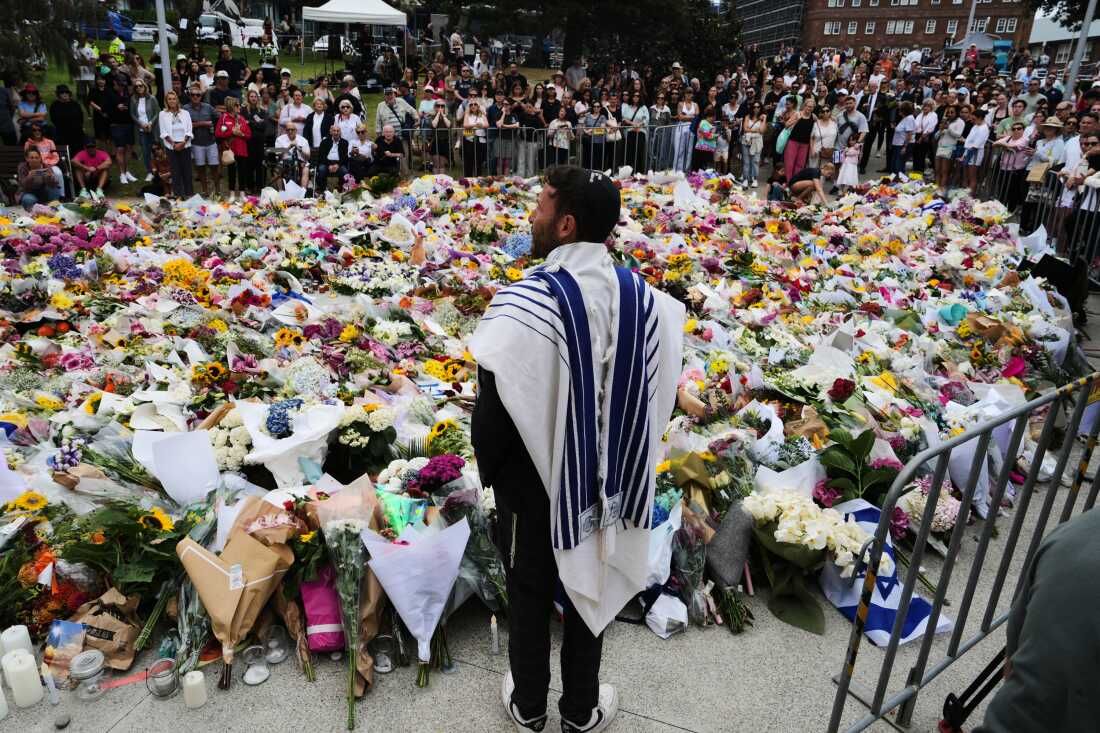
The opening day of Hanukkah this year, a yearly festival where we light candles that, according to Jewish law, have no other purpose than to light the world with its memory of a sacred miracle, began with breaking news of shots fired at an Australian Chabad Hannukuiah lighting ceremony. In what was a ghastly massacre of Jews engaged in nothing other than a religious celebration, two men hunted down fleeing Jews as they murdered fifteen in what is the largest antisemitic attack in Australian history.
The shooters were a father and son: the 50-year-old Sajid Akram, who was killed at the scene by police, and his son, the 24-year-old Naveed Akram, who is currently under police guard in hospital and has been charged with fifteen counts of murder and an act of terrorism, among a total of 59 charges.
This comes just weeks after an attack on a Yom Kippur service in Manchester, United Kingdom, where an assailant drove a car into pedestrians outside a synagogue, killing two people and injuring three others. This has been a year of particularly dramatic antisemitic violence, part of an escalation of attacks since October 7th, 2023. While antisemitism has no categorical connection to anti-Zionism, when Israel is engaged in violence it often functions as an excuse mechanism for those with antisemitic views to act on them, or for legitimate anger to deteriorate into hateful or conspiratorial fabrications. Even while organizations like the Anti-Defamation League often confuse criticism of Israel for antisemitism, the increase is still real, accelerating,and deadly.
At a time when threats against Jews sit alongside threats against queer people, immigrants, Muslims, and others facing historic marginalization, commentators, politicians, and even Jewish leaders have retreated into a siloed discourse on Jewish safety and have been quick to project responsibility onto a Palestine solidarity movement that has no connection to the violence under discussion.
It was no surprise when Israel's right-wing caste immediately siphoned anger and grief from teh killing in the direction of unquestioned support for Israel's military action. “You let the disease [of antisemitism] spread, and the result was the attack on Jews we saw today,” said Israeli President Benyamin Netanyahu in a press conference immediately afterward. “Your call for a Palestinian state pours fuel on the antisemitic fire." Netanyahu is pointing to a notion, central to the ruling Likud Party’s policy and Israeli self-conception, that even the acknowledgment of Palestinian indigeneity and peoplehood or the affording of normal democratic rights would somehow be tantamount to perpetuating anti-Jewish genocide. And while this rhetoric is denounced even by liberal Zionists in the United States, it was also the underlying logic of many of the responses from some of teh loudest Jewish voice and, cewrtainly, their right-wing Christian supporters.
Subscribe to the newsletter
“It started two years ago in October 2023 at the Sydney Opera House,” said Australia’s Special Envoy to Antisemitism, Jillian Segel, blaiming the murders on a completely unrelated and non-violent protest against Israel’s genocide in Gaza. “We heard horrible chants of death to the Jews or kill the Jews or where are the Jews but the intent was clear.” Her claim here was unsupported, as it was with most assertions that anti-Zionist demonstrations called for the death of Jews—something that was almost nonexistent in the growing movement for justice in Palestine. “Words lead to actions and actions lead to things like this, to actual killings,” Segal also said in the interview, suggesting some correlation between demands to end the war and the assault on a Jewish religious event. Far-right populist Australian politician Pauline Hanson went to X to say the violence was caused by “weekly anti-semitic [sic] protests across our nation, hate speech from certain religious clerics, our obnoxious universities."
In the U.S., it wasn’t just political agitators, but mainstream Jewish commentary—both right and left—that suggested either tacitly or explicitly that anti-genocide activism was responsible for this brutality. “Ongoing political intolerance of Israel within segments of Australia’s public discourse has helped fuel an environment in which anti-Zionism too often slides into outright anti-Semitism. When demonization of Israel is allowed to masquerade as legitimate debate, it emboldens those who already harbor hatred toward Jews,” wrote B’nai B’rith International, the foundational organization of the Anti-Defamation League. The New York Times columnist and former Jerusalem Post editor Bret Stephens suggested that anti-Zionist activists were clearly to blame and that, despite knowing nothing about the background of the shooters at the time of his writing, it was “reasonable to surmise that what they thought they were doing was ‘globalizing the intifada.’” Former U.S. antisemitism envoy and scholar Deborah Lipstadt picked up on the same generalized—and untrue—comparison between anti-Zionist demonstrations and Jew hatred, saying that “[on] October 9, 2023, protesters marched … chanting, ‘Where are the Jews?’ … On the first night of Hanukkah 2025, they found them on Bondi Beach—fewer than 20 miles from the opera house.”
Adam Louis-Klein went to The Free Press to write that this attack was simply part of “the long history of anti-Zionist violence,” a phrasing that allows Zionism to capture the story and become more central than antisemitism in the history of anti-Jewish violence. “Like so many Jews, I was woken up,” said frequent Free Press contributor Israeli Liel Leibovitz in the conservative Tablet Magazine, “to news of the massacre in Bondi Beach … and raged as public officials … rushed to publish sanctimonious denunciations, as if they had failed to understand that the shooting was precisely what was meant by ‘Globalize the intifada.’”
Each of the dozens of articles and statements that poured out shared similar framings, if not identical language: that this egregious, antisemitic murder spree was the result of anti-Zionist commentary, which supposedly stokes anger and violence against Jews at large. A number of assumptions sit underneath this discussion, so implicit that they rarely need to be stated: that Jews and Israel are one and the same; that the only reason someone could oppose Israeli violence or Zionism is antisemitism; that resistance to Israeli violence necessitates violence against Jews in the diaspora; and that antisemitism must be tied to anti-Zionism since it is understood as the primary expression of anti-Jewish animosity today. None of the articles actually make a compelling case for this analysis, largely because they emerge from a shrinking consensus that assumes this assessment requires no proof.
This logic comes from a strand of analysis of antisemitism that, particularly since the Six-Day War in 1967, labels anti-Zionism as the “New Antisemitism,” a modern evolution of an age-old anti-Jewish hatred. Antisemitism has taken the forms of religious, ethnic, and political persecution, and because Israel is positioned by major organizations (mostly non-Jewish) as the de facto central bargaining agent of the Jewish people, opposition to Israel is framed as opposition to Jews. The reverse is then assumed to be logically true: violence against Jews must be derivative, on some level, from resistance to the Israeli state.
Subscribe to the newsletter
This is not the historic understanding of antisemitism and requires major leaps of logic, history, and evidence. Still, there is a correlation these commentators are pointing to. When Israel engages in murderous violence against Palestinians—whether after Hamas’ election in 2006, during the 2014 Operation Cast Lead bombing campaign, or amid the genocidal procession following the October 7 massacre—antisemitic harassment and targeting does spike. Antisemitism is real, and antisemites often point to Israel as an expression of Jewish identity and collective will, frequently using pro-Israel rhetoric itself as evidence, since it often frames global Jewry and Israel as one and the same.
But this misunderstands how antisemitism has historically functioned, the narrative it tells about Jews, and where its sources lie. Antisemitism is a conspiracy theory that portrays Jews as a Fifth Column working within institutions of power to subvert popular sovereignty for their own malicious ends. Opposition to Israel can overlap with antisemitism, but only insofar as antisemitic ideas motivate anti-Israel positions—such as false conspiracy theories about Jewish control of global politics or the belief that Judaism itself contains inherently evil ideas that inspire Israeli state violence.
The actual history of antisemitism emerges from Christian Europe: from supersessionist theologies that argued Jews no longer needed to exist now that the Church had replaced them, and from the economic and political conditions that allowed Christian empires to target, maim, and slander Jewish communities. Some Jews were forced into intermediary economic roles such as moneylenders or tax collectors, and with the advent of modernity these older religious accusations were secularized into the conspiracy theories we recognize today about Jewish bankers, cabals, and imperialists. This history did not originate in Muslim communities or on American university campuses; it began in churches that many in the U.S. continue to venerate as sources of moral virtue and even as protectors of Jews through unquestioning Christian Zionism. When we examine antisemitic conspiracy theories in Muslim-majority countries such as Iran, Egypt, or Pakistan, they are often explicitly Christian in origin, with superficial Islamic elements layered on top. Voices that fixate on “Muslim antisemitism” or anti-Zionism as the primary danger frequently claim there is an indigenous antisemitism within Islam itself, ignoring how Christian antisemitic ideas were exported into the Middle East, how Nazi ideology traveled outward, and how European imperialism globalized not only power and commerce, but its worst ideas as well.
Insofar as the shooters had an ideology, it was a form of antisemitic authoritarian Islamism that emerged far from the West Bank or Gaza, most clearly within the Islamic State (IS), which was also part of the orientation of the Manchester killer. There are some allegations that the two had coordinated with IS representatives in the Phillipines, but what is more verifiable is that they had ISIS paraphernalia at home and showed at least ideological affinity with the movement. There is a deep strain of antisemitism in IS doctrine, which portrays Jews as controlling Middle Eastern politics and targeting Islam. IS portrays Jews as engaging in a "war against Islam" that centers clear Western antisemitic ideas about Jewish power, though adding some of it's native spin (such as using antisemitic conspiracies to slander Shia Islam). This is a relatively recent ideological development, both within Islamism and within Islamic theology more broadly, and it closely resembles the features of authoritarian far-right movements across the world. Antisemitism has become a common component of right-wing populist conspiracy theories globally, in large part because Western political culture has set the terms for many of the dominant myths and narratives of the post-colonial world. When we examine the Islamic State, we see political programs that mirror the far-right, nationalist—often quasi-fascist—movements we confront across Europe, North America, and Israel: a shared politics of scapegoating and the redirection of popular anger toward imagined enemies.
This reality is almost entirely ignored by major anti-antisemitism organizations and well-funded pundits, who instead insist on treating antisemitism as exceptional and locating its source primarily in Islam or global solidarity movements, rather than in the traceable evolution of antisemitic ideology. Antisemitism tracks alongside other forms of bigotry and authoritarianism, and given this shared struggle, the ability for large majorities to find common cause should be an obvious strength. Instead, the strategy appears to be to further isolate Jews from all other peoples. Maybe the walls we’ve built aren’t high enough. Maybe we should fortify them even more.
But not everyone agrees, particularly young Jews and those whose sense of fighting antisemitism is rooted in antifascism rather than “countering violent extremism.” The Jewish left has long offered the concept of “safety through solidarity”: what if the threats facing Jews are fundamentally the same threats facing most marginalized communities? What if we united across lines of difference to fight the far-right—whether white nationalist or Islamist—and dismantle the conspiracy theories and social hierarchies that keep us divided? Israeli politics have only grown more extreme, and measures enacted in the name of fighting antisemitism have become increasingly repressive and volatile, yet none of this has made Jews demonstrably safer. At a moment when combating antisemitism is used to justify widespread repression, violence against Jews has increased both in Israel and the diaspora. Perhaps it’s time to build alliances that give us the power only mass movements can provide.
The worst lesson to draw from the Bondi Beach shooting is that Jews need more fences and that the political left, rather than the far-right, should bear responsibility. The memory that came up for many was the Christchurch, New Zealand mass murder of 51 people at the Al Noor Mosque, a comparison that highlights shared experiences between Jewish and Muslim communities that can act as a point of mutual empathy from which a shared community can arise. Only by building networks of community defense—ones that cross identity lines and develop shared strategies—can we meaningfully change this situation, both in terms of immediate safety and in dismantling the structures that generate this violence in the first place.
This incident happened alongside a very different one, but both highlight a fundamental mistake in the conception of antisemitism. In a recent agreement to end a Title VI complaint, Pomona College—despite stating that it would ensure all students are treated equally regardless of ethnicity, religion, gender, or other protected categories—outlined a framework in which Jews would, in fact, be treated differently. Special consideration for Jews would be applied, and political speech would be analyzed for potential antisemitic content, possibly according to whether it meets the specifications of the International Holocaust Remembrance Alliance definition of antisemitism.
This mirrors developments at Harvard, Columbia, UCLA, and many other universities, all of which have seen their budgets threatened over the perception that they have condoned antisemitism through anti-genocide campus encampments. But beyond being an obvious tool to restrict speech and a pretext to cut federal funding, these measures separate Jews from broader attacks on Diversity, Equity, and Inclusion. The underlying logic is that Jews require different considerations, separate from all other groups, in order to be safe.
Instead of recognizing that many communities may be unsafe in the current political climate—an acknowledgment that could highlight a shared vulnerability and common fate—this approach fractures solidarity by positioning Jewish safety as dependent on the curtailment of others’ rights. Across universities, cities, and states, the solutions offered for Jewish safety increasingly emphasize Jewish distinctiveness and separation: sometimes through special law enforcement measures, other times through the belief that only a well-funded and militarized Israeli state can provide protection.
But beyond being statistically ineffective—particularly in the case of Israel, which remains one of the least safe places for Jews to live—this framework lacks the ability to cultivate the mass alliances necessary not only to address immediate safety concerns, but to transform the conditions that produce violence in the first place. It cannot generate the kind of durable, collective power required to create lasting safety for Jews or for anyone else. Until we acknowledge that we are safer together than we are apart, that no partition wall or checkpoint or armed guard will ultimately solve the roots of our danger, we will never even begin to look to where true safety can lie. Solidarity is only possible when borders are broken.
What many of the articles published in the aftermath ignored was that it was a local man, Ahmed al-Ahmed, a 43-year-old Muslim fruit shop owner, who wrestled the long gun away from the shooter and stopped the massacre from continuing. We don’t know his views on Israel, but they likely differ from those of the loudest voices insisting that unquestioned support for Zionism is the only way to honor Jewish lives. His act of bravery was not easy—he was shot several times and will likely suffer permanent damage to his shoulder and hand. But he saved lives. Not the police. Not militarized security. We should pay attention to who actually keeps us safe. And if we continue to demonize our potential allies, we will never find a pathway to lasting Jewish—or collective—safety.