Reading Folk Horror in 2026
Folk horror has had various waves of popularity, most obviously in the 1970s and onward in British horror film. But in the last few years it has increasingly become a staple of the literary horror scene as a certain inward gaze has started to percolate. Folk horror is roughly horror stories that center around a person encountering an ancient folkloric creature or cult, often brought into a modern setting. The genre’s history is largely cosmic; it deals with the anxieties that sit underneath particularly colonial societies that simultaneously eradicated and demonized the ancestral traditions they largely extinguished with their imperial attribution of religion. Stories about pagan worship have for millennia now, even borrowing from earlier religious propaganda, been built around framing the non-normative religion (for the settler) as uniquely malevolent and often tied to the more demonic elements of the new theology. These are what scholar Roger Luckhurst names "survivals," little pieces of belief, rituals, or even remote memories that continue into modernity even while disconnected from their source. Pagan practitioners, particularly women or people who practice folk traditions meant to defy the larger military might, are seen as particularly threatening, and this sits underneath particularly European Christianity.
As we see with Lovecraftian traditions, our existential dread about social collapse is perfectly triggered along with an often unspoken anxiety about the spiritualities and folkways that are barely remembered, but carried in the land we sit on. Since The Wicker Man started the English folk horror craze, stages of revival have happened, which has hit a particular zenith in the past several years. One element that a new scholarly book by Dawn Keetley and Ruth Heholt points out is that while the heyday of folk horror may have been the ’60s and ’70s, our consciousness of it as a genre makes it easier to reproduce and to build a canon around. This means that even if there isn't a conscious boom, our consciousness of it as a genre means we are piecing together various horror ephemera and naming it as folk horror, thus reinforcing its interest.
When reading new horror in 2026, folk horror (as well as cosmic horror, which we’ll get to in the next post) is continuing to dominate, but is now carving itself out as a horror staple rather than a passing fad. Last year’s more horrific novels were all folkish, such as Old Soul by Susan Barker, Atlas of Unknowable Things by McCormick Templeman, and Moonflow by Bitter Karella. It has been even denser in 2026, so I wanted to review some of the new folk horror offerings from this year so far and some older gems I didn’t encounter until recently.
Subscribe to the newsletter
Home Sick - Rhiannon Grist
New novelist Rhiannon Grist’s novel attempts to intensely personalize Scottish folklore in a way that, while not particularly inventive, does ultimately come together in a particularly satisfying and surprisingly frightening way. The book follows a woman who, after a particularly volatile incident at her office job, has quit and bought a home in rural Scotland. Well, half of a home. She finds the other resident of the duplex strangely familiar, but is mostly haunted by her own sense of anxiety, fear, and, ultimately, an unquenchable rage at what she’s been through. The book’s early chapters are a bit of a challenge given that they slow down to share our narrator’s internal struggles, but once she is embedded into what largely understands folklore’s metaphorical potential, the earlier delays feel earned.
The Cold House - A.G. Slatter
This was actually a late 2025 novella, but most people didn’t get a chance to read it until this year, which was my excuse. A.G. Slatter is better known in the fantasy world, which is what makes the pacing and delivery such a surprising joy. After the death of her husband and daughter, a woman makes her way to a distant family estate she never knew about: one of the apparently many things her husband never disclosed. What she finds is a deep family secret that runs through England’s history, particularly the upper classes and how they have enslaved more than just the peonage they rule over. This is emotionally satisfying and quick, a book I would recommend to almost any level of horror reader.
Polybius - Collin Armstrong
This is not going to fit the bill for almost any folk horror list you read, but I’m adding it here because it sits in the still undefined space between folklore and urban legend. It’s about an early 1980s arcade machine that hypnotizes those who play it into acting out fits of deadly rage. The premise is as strong as any I have read in recent years, but there are missed opportunities right from the start, and the last hundred pages cascade into silly and trite denouements that avoid even trying to satisfactorily address the world they have created. The book is written by a screenwriter and has a sort of popular cinematic feel, but both over- and under-explains itself and then abandons literary rhyme or reason in the third act. I would stick to this only for those obsessed with what is apparently a newly popular subgenre of video game horror.
The Mean Ones - Tatiana Schlote-Bonne
Tatiana Schlote-Bonne is better known as a Young Adult writer, and you can feel that immediateness and lack of frill in The Mean Ones, a story that watches a woman’s very forgiving relationship with her physical therapist boyfriend quickly dissolve into reality. Taking place in two time periods, one where she witnesses a brutal crime as a teenage camper and another where that memory lords over her current relationships, Schlote-Bonne really delivers on a surprisingly complex character piece in direct language with the pace of a thriller. This was a lot of fun and fits genre conventions well while also unpacking the ways trauma can force us to ignore abuse even when it’s right in front of us.
Come Sing for the Harrowing - Dan Coxon
Perhaps the biggest surprise of the year, Come Sing for the Harrowing is a collection from British horror author and editor Dan Coxon that spans a number of years and scores a win with almost every story on the list. The title story I first encountered in last year’s Roots of My Fears: Terrifying Stories of Ancestral Horror, a fantastic big-press anthology featuring a running list of known literary horror names. Coxon has been a staple of the horror scene now for decades, but not a particularly well-known feature, and so many of these stories likely missed even dedicated readers. Single-author collections are often hit and miss, but there are few misses here, and this has come together as one of the best horror books of the year.
Subscribe to the newsletter
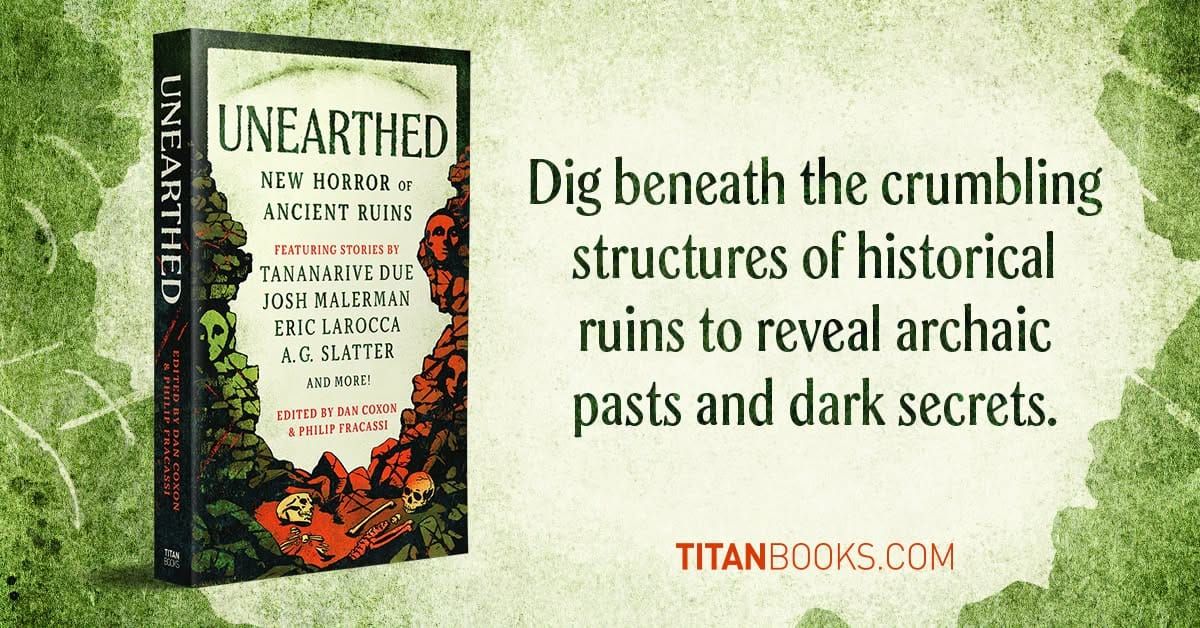
Unearthed: New Horror of Ancient Ruins - Ed. Dan Coxon and Philip Fracassi
This was among my year’s most anticipated, in part because of my consistent appreciation of Philip Fracassi, but also Dan Coxon’s name once I had the chance to read Come Sing for the Harrowing. This is largely similar to last year’s Roots of My Fears, a mainstream folk horror anthology based on the concept of ancestral memory and tradition. The book is full of established authors like Tananarive Due, and while the stories are almost one-for-one a good canon, there are few standouts other than Eric LaRocca’s contribution. Still, this is probably the folk horror anthology I would hand a new reader right now since it is rather enjoyable start to finish and features a smart and engaging collection of stories.
All Hallows Eve - Ed. Ellen Datlow
This is not technically a folk horror anthology; it’s themed around Halloween, but so much of it is focused on the legacy of the Celtic pagan holiday Samhain or folk legends regarding witches, wights, and spirits of the land. While perhaps not the strongest book of the year, it has some real gems that I expect to be in next year’s The Best Horror of the Year anthology, given that Datlow often prefers stories she herself edited. My most anticipated was John Langan’s rather long piece, which I admired for his willingness to stretch into Scottish folklore even if it wasn’t my particular favorite. The real standout is Theresa DeLucci’s “Give Me Something Good to Eat,” as well as impressive offerings by Brian Evenson (“Ankou’s Night”), Alma Katsu (“The Kuker”), Josh Malerman (“That Hannie Agnes”), Stephen Graham Jones (“The Devil’s New Year”), and Livia Llewellyn (“The Levels”).
Grace - A.M. Shine
This was high on my list given Shine’s recent fame as the author of The Watchers, a fabulous novel now a rather mediocre film. Shine is known for dragging Irish folklore into the present with a kind of visceral contemporary relevance that is hard to match (a reason why so many folk horror authors choose historical fiction rather than attempt to make folktales work in modernity). While avoiding spoilers makes it difficult to explain, our original narrator returns to the remote island her birth parents were from to find answers about her history. What she locates is a cosmic break that is holding residents in a literal cycle of trauma and impotence. The book’s handling of folklore is rather adept, though shifting perspectives after the first third of the book creates some narrative disruptions that are never truly repaired. Still, a strong example of what folk horror can be when you establish the relevance of folk stories to a modern reader and show what is truly perennial about them.
Morsel - Carter Keane
This novella is more aligned with Adam Nevill’s model of folk horror: we encounter a cultic milieu that is enacting a bloodthirsty plan based on its commitment to the treasures of the Old Gods. It is fast-paced and short, perfect for a plane ride (which is where I read it cover to cover), though it doesn’t break much new ground. The story grounds us in a particular working-class experience and the exploitation felt in particularly visceral ways by those who finally establish what could be a path out of poverty by entering into a working world never before thought accessible. Because of this, there is a lot here that will feel relatable even if the actual horror mechanics feel a bit dated, or familiar.
Monumental - Adam Nevill
And speaking of Nevill…this is his latest folk horror offering, and its resonance with his past work will be immediately familiar. Nevill’s folk horror may be best known through The Ritual, which became popular after it was adapted into a Netflix film of the same name. Nevill is an established quantity in British horror who moved into independent publishing to continue his work the way he prefers with his publishing house, Ritual Limited. This has led him to a string of books that are, if we are to be honest, quite similar to one another, yet done with a kind of expert pacing and familiarity with how cosmic folk horror works that we are able to forgive it. Monumental is part of a string of work engaging in a folk canon of monsters and gods of Nevill’s creation, including The Reddening, Under a Watchful Eye, Cunning Folk, The Vessel, and now, Monumental. All are good (though The Reddening was my favorite and Cunning Folk was simple and fun), and so Monumental helps to build out a pantheon that, while unique, rather comfortable for those who have spent their time slogging through real folklore of the British Isles. Ultimately it is a survival story and matches Neville’s typical pacing (which means quick, though I still could have shaved off a little length). This may be a good entrypoint to Neville as well, a little simpler than The Reddening and an easy way to be invited into his mythos.
***
There remain a number of high-profile folk horror books that have either not been released or I have not opened yet. Highest on this list is Stephen Graham Jones’s sequel to the bestselling The Only Good Indians, Off the Reservation, which is likely to be among the most purchased horror novels of 2026. Also just released is Quaint Folk, the latest novel by Bitter Karella, whose Moonflow was among my favorite novels when it was released last year (and while I just started Quaint Folk, it's already a gem). I’ll keep you up to date with other folk horror books for the rest of the year, as well as another look at cosmic horror and our best of 2026 horror roundups!